

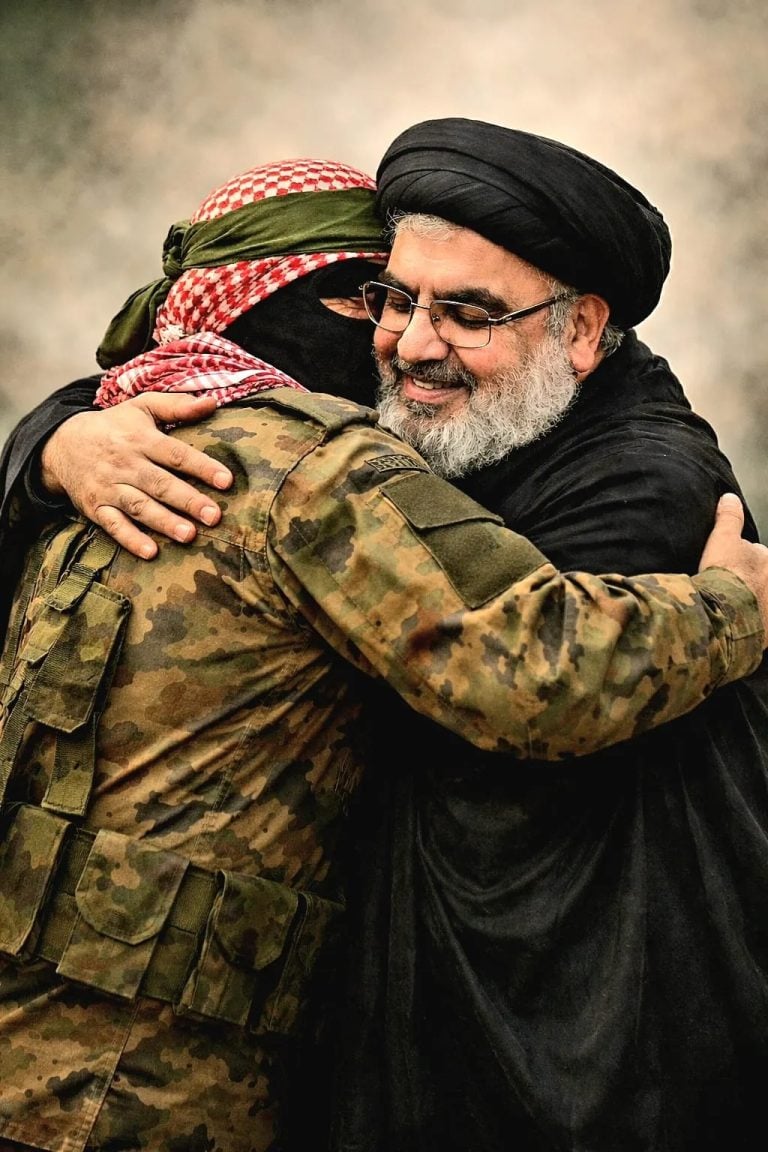
Figures like Hassan Nasrallah and Abu Obaida matter in ways that go far beyond politics. They summon in us a depth of feeling that politics alone can never touch. Not mere admiration. Not even respect. Something far more intimate, almost unsayable — a form of love that lodges in the chest like a second heartbeat.
I do not mean the language of fandom or political loyalty. I mean the love that carries the emotional gravity of belief — the same love that causes people to whisper, “Jesus loves me, this I know,” in the dark, or to confess, voice breaking, “I love Jesus so much I am brought to tears.” It is the love that arrives when the soul has nowhere else to turn.
It is the love one feels toward something that has held one together in moments when nothing else could. It is never about the person alone; it is about what their presence unlocks inside you — a space where despair had once taken root, now filled instead with defiant possibility.
That is the love I have seen, and felt, around both Nasrallah and Abu Obaida — a love that rises from the experience of being protected from collapse: from despair, from erasure, from the sense that one’s suffering is meaningless or unmoored from history.
Their words, their persistence, their refusal to let the future disappear give people something no political program can offer: the feeling that life still makes sense, as if an ancient olive tree had taken root again in soil long declared barren, offering shade and oil where despair had threatened to parch everything.
This is what empires consistently fail to understand — and what condemns them to repeat the same astonishment. They calculate interests, capabilities, resources, leverage. They have no instrument to measure love of this kind.And so they remain perpetually bewildered when the bullet enters the body, yet the thing it carried — the stubborn flame — refuses to be extinguished, only spreads.
At a certain age — and I am there — one begins to think about endings, not only one’s own but those that belong to the worlds we inherited and fear we may fail to pass on, with a new, almost merciless clarity. Not only about one’s own death, but about the quiet terror that the things which gave my life meaning might not survive in the memory of my children, my grandchildren. Will they carry forward not merely my name, but the convictions, the struggles, the unfinished arguments that stitched my existence into coherence — or will those threads unravel in their hands?
The approach of a new year sharpens this awareness. We stand, briefly, at the edge of the near future while still alive — peering ahead even as time is already withdrawing behind us. It is a moment when personal mortality and historical continuity converge.
It is impossible, in such moments, not to think of figures like Hassan Nasrallah and Abu Obaida — not as distant political icons, but as human lives whose abrupt ends forced millions of us to confront the same question at a collective scale. The sorrow and pain their executions produced were not only for what had been lost. It was for the sudden vacuum in the timeline — the sense that a thread binding past to future had been violently severed.
And yet that grief collapses into hopelessness only if one believes that life ends at the body. Not in the theological sense — though both men were deeply religious and fully certain of their place with God — but in the historical sense. If one does not believe in a form of afterlife on this earth, then execution becomes erasure. But if one understands afterlife as the continued presence of a life inside memory, movement, language, and future action, then execution becomes something else entirely — a form of afterlife that demands caretakers rather than believers.
These two figures now inhabit the future. We have been entrusted with what a thinker once called a weak messianic power — not fragile in its impact, but fragile in its dependence on the living: a claim the past makes upon us to keep the defeated from final oblivion. Their voices, their refusal, their abrupt ends — all of it reaches forward now through those who remember, who carry, who persist.
Hassan Nasrallah has entered the temporal field of our future, articulating possibility as a discipline rather than an emotion. He spoke as if time itself awaited his command. He narrated as well as reframed history.
When Nasrallah said,
“In the end, we are part of this region, and we are affected by its developments. What we may do or not do in the future depends on the nature of what happens here in the region,” he was placing the future into collective agency, refusing the resignation of inevitability.
His rhetoric always tethered possibility to action and refused the seduction of fatalism that empire relies upon — not hope as passive longing, but as strategic will.
In another telling expression, he asserted,
“Israel is our enemy… Its destiny is manifested in our motto: ‘Death to Israel.’”
Here Nasrallah refuses not only occupation but the erasure of destiny. Destiny is a word about the future; it is where meaning and time converge. There is no neutrality, no shrugging into resignation — only a future that must be defended by collective agency.
Abu Obaida’s authority was of a different order — less a singular presence than a conduit for a collective grammar of endurance. His was not the visible presence of a charismatic leader, but the quiet, persistent voice of structural continuity. His language never sought to announce a future; it sought to embed his people within it.
In one of his addresses marking the anniversary of the broader resistance struggle, he invoked resilience and continuity when he said,
“Our land nurtures resistance fighters as it nurtures olives” — a metaphor that collapses geography, lineage, and struggle into a single continuum.
Resistance is not episodic; it is organic and perennial. Resistance is not something that ends with death; it grows where life endures.
In another recorded statement, he affirmed the unbroken nature of resistance even under the harshest pressure, reminding audiences that the enemy’s “failure in confronting the resistance and breaking our people is evident … despite war and atrocity.” Such phrasing both refuses defeat and frames continuity as a structural fact of the political life he spoke for.
Abu Obaida’s masked voice never proclaimed I am here.
It proclaimed, quietly, relentlessly, we still persist — the voice of an entire people speaking through one hidden face, as if the land itself had learned to speak.
And when the announcement finally came — on December 29, 2025, four months after the strike — with his real name, Hudhayfah Samir Abdullah al-Kahlout (or Huthayfa Samir Abdallah al-Kahlout), revealed for the first time, his face shown in photographs, his martyrdom mourned in a new voice that carried the same title — it was not an end, but the clearest declaration yet: I persist. Not the man alone, but the unbroken structure itself. The mask lifted did not expose fragility; it exposed deep roots. It revealed that anonymity had never been concealment, but a method of distributing the self across a people. What was meant as confirmation of erasure became the tree’s quiet proof: it had been growing all along, drawing sustenance from the very soil the enemy sought to scorch. The new Abu Obaida, masked once more, speaks the old one’s truth anew: the voice is not the face. The voice is the land, the people, the refusal that outlives both, sending new shoots from the same ancient trunk.
Nasrallah’s language rendered the future defendable — grounded in agency, strategy, and collective will.
Abu Obaida’s language rendered the future inevitable — grounded in continuity, growth, and structural perseverance.
When I was in Beirut recently, I felt Nasrallah’s presence everywhere — a reminder that the future had not collapsed with the man — not only in the vast billboards along the airport road or across al-Dahiya, but in the smallest, most intimate places: the mirror of a taxi, a sticker on a shop window, a photograph taped above a register, a face that watched over the city as if time itself had chosen to remember him.
It was not the spectacle that moved me most, but the sheer density of that presence — the way one life had seeped into the everyday texture of other people’s days: He was not being commemorated. He was being carried — forward, breath by breath, into the future he helped make possible.
Rima Najjar is a Palestinian whose father’s side of the family comes from the forcibly depopulated village of Lifta on the western outskirts of Jerusalem and whose mother’s side of the family is from Ijzim, south of Haifa. She is an activist, researcher, and retired professor of English literature, Al-Quds University, occupied West Bank. Visit the author’s blog.
She is a Research Associate of the Centre for Research on Globalization (CRG).
Culled from Global Research





Leave a Reply