

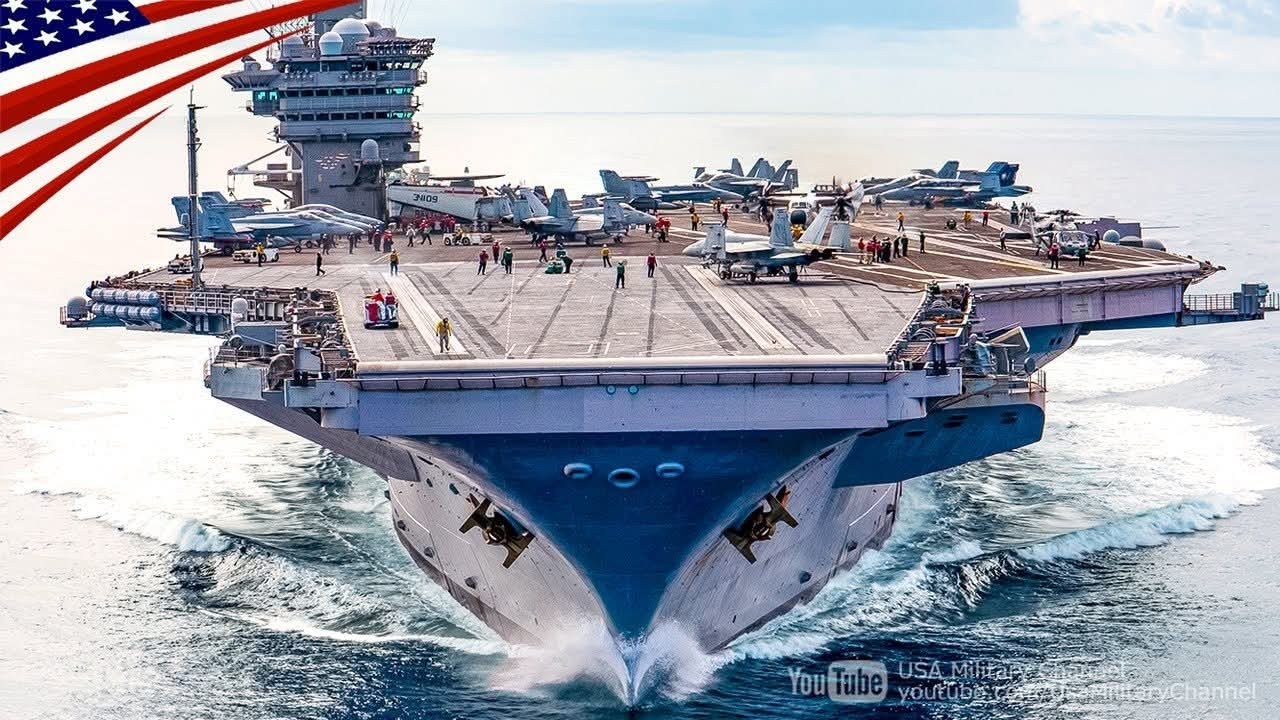
The United States Navy’s aircraft carriers Ford, Truman, Abraham Lincoln glide across oceans as symbols of power, but their gleaming decks hide a troubling truth, these floating cities of steel are relics of a bygone era, no longer designed for the high tech, precision strike world they now face. Like tanks and paratroopers before them, carriers were optimised for a 20th century battlefield, and today they function more as instruments of coercion than decisive warfighting platforms. Against second rate states, carriers intimidate and dominate. Against Iran, they are sitting ducks expensive, visible, and politically irreplaceable.
Washington seems to have misread the lesson. Buoyed by an easy victory against Venezuela, the US political and corporate class Trumps election donors, planners, contractors, and think tank analysts are steering the Navy toward a far more dangerous adversary, Iran. This is a tiger compared to Venezuela’s paper mache bear.
As of late January 2026, the United States has deployed a significant naval force to the Middle East amid escalating tensions. The USS Abraham Lincoln (CVN‑72) leads a U.S. naval “armada” in the region, supported by multiple guided missile destroyers and cruisers. This massive force posture is intended to deter Iranian aggression, protect shipping lanes, and support allies, including Israel. Military analysts note that the deployment is as much about signaling and media narrative as it is about operational readiness [Source Reuters and AP media]
Yet, despite the sheer scale, these deployments do not guarantee security. Carriers are highly visible, costly, and vulnerable platforms, and Iran has the capability to target them effectively. History shows why this matters. In the 1982 Falklands War, Argentina’s French made Exocet missiles and low altitude bombs inflicted serious losses on the British fleet, despite being relatively rudimentary by modern standards. On 4 May 1982, , HMS Sheffield was struck amidships by an Exocet, killing 20 crew and wounding 24 others, the ship was abandoned and eventually sank on 10 May while under tow. HMS Atlantic Conveyor was hit on 25 May, destroying critical helicopters and logistics equipment, while HMS Ardent and HMS Antelope were sunk by bombs, and HMS Coventry was lost during decoy operations. These attacks did not rely on today’s precision targeting pilots used low level bombing and basic radar guidance yet the results were strategically decisive, straining British air defenses and forcing rapid operational adjustments. Incidentally, during the Falklands War, French made Exocet missiles used by Argentina were a major threat to the British fleet. Although France formally imposed an arms embargo once the conflict began, a French technical team remained in Argentina throughout the war and helped address missile launcher faults, making the weapons operational against British ships such as HMS Sheffield and Atlantic Conveyor. This technical support even if limited and informal exemplifies how small amounts of outside assistance or proxy help can have disproportionate consequences in warfare. It also shows that corporate welfare often takes precedence over alliances, France and Britain were officially allies in 1982, yet economic and industrial interests guided behavior more than nation solidarity. In these scenarios, the term often used is, “It’s just business, nothing personal.”
Today, Iran possesses far more sophisticated missiles, drones, and ISR (Intelligence, Surveillance, Reconnaissance) systems than Argentina in 1982. Satellites, drones, and electronic surveillance allow Tehran to track carrier movements in real time, identify vulnerabilities, and cue missiles with precision. Against such capabilities, U.S. carriers do not need to be sunk a single successful strike could paralyse flight operations, undermine deterrence, and humiliate Washington globally.
The lesson is reinforced by the Yemen Houthi incident, where a relatively small poorly armed unit launched a missile and successfully struck a US warship, forcing an unreported retreat. If a minor actor can impose such costs, imagine what a peer capable adversary like Iran can do. The 12 day war with Israel provides an even clearer warning, Iran’s missile and drone strikes pummeled Israeli targets far beyond expectations, exhausting US supplied air defense ordnance and forcing Washington to negotiate a ceasefire, a shock Israel was unprepared for. This time, if conflict escalates, Iran could also target Jerusalem, Tehran does not need to win outright, demonstrating capability is enough to force withdrawal, concessions, and humiliation.
Modern carriers are also perpetual maintenance and corporate welfare machines. Unlike a battleship, their power depends entirely on aviation 70–75 aircraft with no heavy shipboard artillery and the complex systems that keep them operational. Even when not deployed, carriers require constant maintenance, propulsion testing, and system overhauls. Aircraft and ordnance have shelf lives and must be replaced continuously. Training sorties consume munitions that require replenishment.
Think of it like an everyday car. It generates constant tax revenue through fuel taxes, registration, insurance, and even routine maintenance tyres, spark plugs, oil changes, and running gear replacements. The car is arguably the greatest tax revenue generator any government has, producing income the state can reliably count on. A supercarrier operates on the same principle, but on a vastly larger scale. Its maintenance, flight operations, ordnance replacement, and upgrades ensure a perpetual stream of contracts, jobs, and profit for shipyards, contractors, and suppliers. The carrier’s strategic function is almost incidental to this profit loop. From a systemic corporate-welfare perspective, its primary purpose is to keep money flowing through the defense-industrial complex. This is why the military corporate welfare industrial complex thrives on war, the threat of war, and perpetual training for war it is how the beast lives, grows, and survives.
The United States is not just miscalculating it is structurally incentivised to miscalculate. A single carrier hit would not only expose tactical vulnerability, it would also reveal the corporate and political machinery driving its deployment. In other words, this is not merely a military problem, but a systemic one. History, geography, and physics all converge to make overconfidence dangerous. In biblical terms, it is vain self-confidence.
Yet, if history is a guide, common sense will prevail. US planners already know the carriers are vulnerable in this environment, the current naval build up is as much about media narrative and domestic optics as it is about operational capability. The show of force sends a message, but it is unlikely to escalate into the kind of conflict that could truly humiliate the United States. This is theater billions spent, headlines grabbed, but real strategy carefully restrained.
Iran does not need to provoke war to secure strategic advantage, its mere capability and readiness shapes behavior. Against this backdrop, U.S. carriers are less instruments of war than symbols of illusion, maintained at immense expense by the corporate welfare military industrial loop. Even simply having the fleet arrive and wave the U.S. flag generates billions back into the profit stream. This is why a multi carrier force has been deployed rather than just one. The next confrontation will be less about missile counts and more about humiliation and history shows that humiliation travels faster than headlines. As President Kennedy observed, “Victory has a thousand fathers, defeat is an orphan.” Defeat may be respectable, but humiliation stings in eternity for those involved.













Leave a Reply